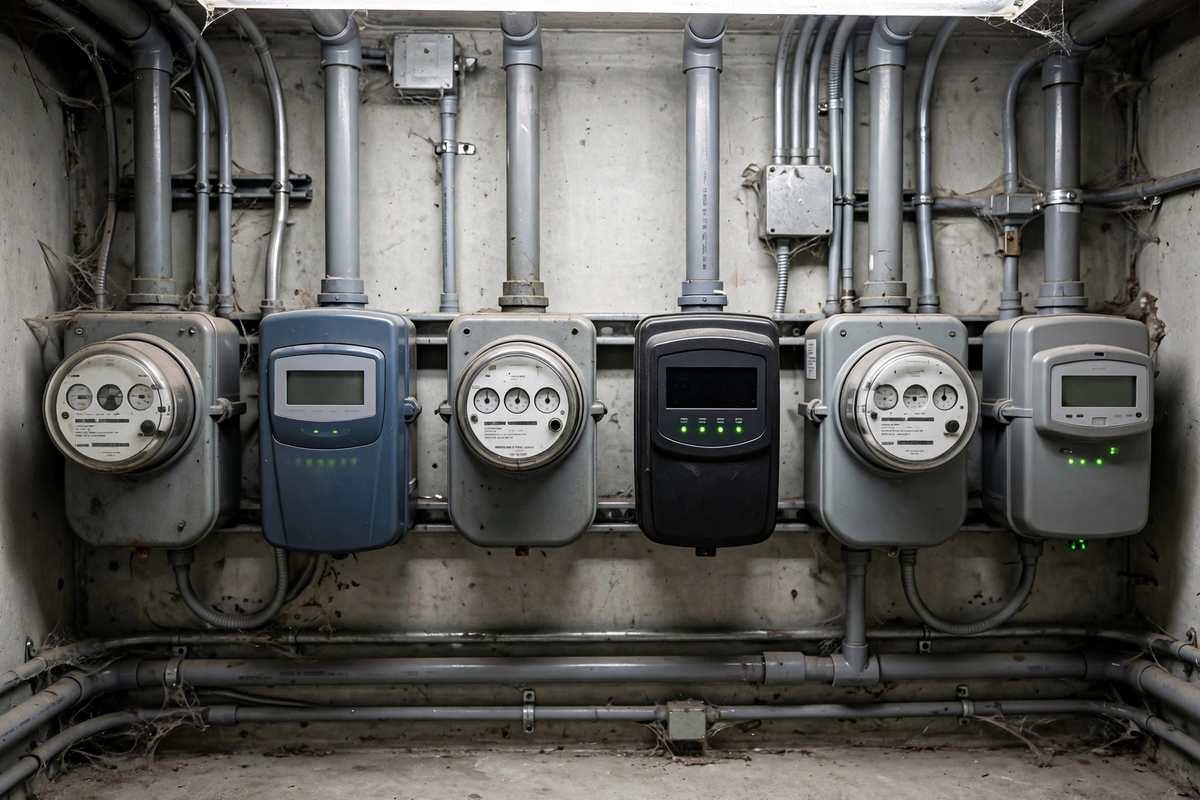
Open the utility closet in any apartment building and you will find the equipment that decides how tenants pay for electricity, water, and gas. In some buildings, each unit has its own meter owned by the utility company, and tenants pay the utility directly. In others, the landlord installs private submeters behind a single master meter, reads them, and bills each tenant for its measured usage. The difference between submetering and direct metering affects your bills, your rights, and your leverage in billing disputes.
Both systems are common, both are legal in most jurisdictions when done correctly, and both are abused often enough that tenants and landlords need to understand the rules. This guide compares how each system works, the legal limits on landlord billing, the pros and cons for each side, and what to check in your lease before a dispute arises.
How Direct Metering Works
Direct metering, also called individual metering, means each rental unit has its own utility-owned meter. The tenant opens an account with the utility company, the utility reads the meter, and the tenant pays the utility’s bill directly. The landlord is out of the billing chain entirely.
This is the simplest arrangement for everyone. Tenants pay the regulated utility rate, with no landlord markup, and they deal with the utility’s consumer protections: regulated billing practices, payment plans, and complaint procedures through the public utility commission. Landlords avoid the administrative burden of reading meters, calculating bills, and chasing utility payments.
Direct metering is standard in most single-family rentals and in newer apartment construction, where building codes in many jurisdictions now require individual meters for new multifamily buildings. It is less common in older buildings, where retrofitting individual utility meters can require expensive electrical or plumbing work, and in commercial buildings with complex shared systems.
How Submetering Works
Submetering means the utility sells service through one master meter to the building, and the landlord installs private submeters for each unit or space. The landlord, or a third-party billing company, reads the submeters and bills each tenant for its measured consumption. The tenant pays the landlord, not the utility.
Submeters can measure electricity, water, gas, and sometimes heating or cooling delivered through a central system. The hardware ranges from simple mechanical meters to smart meters that transmit readings automatically. Installation costs fall on the building owner, and in many states the law prescribes meter accuracy standards, testing requirements, and billing formats.
Submetering is widespread in older apartment buildings, mobile home parks, and commercial properties where direct metering is impractical. It gives tenants the conservation incentive of paying for what they use, which is its main policy justification: when utilities are simply included in rent, nobody has a reason to conserve.
The Legal Limits on Landlord Billing
Here is the rule that matters most: in most states, landlords who submeter cannot charge tenants more than the utility would charge. Many states prohibit landlords from marking up utility rates or profiting on the resale of utility service. The landlord may recover the actual cost of the service, and in some jurisdictions a reasonable administrative fee, but the per-unit rate must track the utility’s tariff.
States regulate this differently. Some require landlords to bill at the exact utility rate, including tiered or time-of-use structures. Others allow averaging or a simplified rate schedule, provided the total collected does not exceed the master bill. A few states require landlords to register as submetering operators or to use billing companies that comply with specific disclosure rules. Violations can trigger penalties, refund obligations, and in some states, tenant rights to treble damages.
Common areas add a wrinkle. The master utility bill includes common-area consumption: hallway lighting, elevators, laundry rooms, irrigation. Landlords cannot simply divide the whole master bill by the submetered totals and pass the difference to tenants as if it were their usage. Common-area costs belong in rent or in operating expenses, not hidden inside inflated submeter bills. If your submeter charges consistently exceed what the utility rate would produce, ask for the math.
Reading Your Submeter Bill
A lawful submeter bill should show your meter readings, the consumption for the billing period, the rate applied, and how that rate relates to the utility’s tariff. Compare the rate to the utility’s published residential or commercial rate for your area. Small differences may reflect legitimate rate-structure averaging, but large gaps deserve questions.
Watch for these red flags: a flat per-unit fee with no meter readings shown, rates significantly above the utility’s tariff, administrative fees that dwarf the actual usage charge, estimated readings month after month without actual reads, and bills that arrive with no way to verify the numbers. Each of these suggests billing that may not comply with state rules.
Tenants have the right to see the underlying data. Ask for the master utility bill, your submeter reading history, and the rate calculation. In many states, landlords must provide this on request. If the landlord refuses, that refusal is itself informative, and a complaint to the public utility commission or the state attorney general’s consumer division is the next step.
Submetering vs Direct Metering: The Comparison
For tenants, direct metering is usually better. You pay the regulated rate, you get utility consumer protections, and billing disputes go to the utility commission rather than to your landlord. The main downside is account setup: deposits, credit checks, and the hassle of opening and closing accounts when you move. Your utility setup checklist for a new apartment covers the direct-metering move-in process.
Submetering’s advantage for tenants is conservation fairness: you pay for what you use rather than splitting an averaged cost with wasteful neighbors. In buildings without submeters, landlords often allocate utility costs by square footage or headcount, which punishes frugal tenants. Submetering fixes that, provided the billing is honest. Its disadvantages are the loss of direct utility protections and the information asymmetry: the landlord controls the meters, the readings, and the math.
For landlords, submetering recovers utility costs that would otherwise be baked into rent, and it encourages conservation that lowers the master bill. The costs are administrative: meter maintenance, reading, billing, collections, and regulatory compliance. Third-party billing companies handle this for a fee, but the landlord remains responsible for compliance. Direct metering avoids all of it, which is why landlords generally prefer it where the infrastructure allows.
What Your Lease Should Say
Whether your building is submetered or directly metered, the lease should address utilities explicitly. For submetered units, the lease should identify which utilities are submetered, state the billing methodology, cap or define administrative fees, give you the right to inspect meter readings and the master bill, and state that rates will not exceed the utility’s tariff. Vague language like tenant pays for utilities as billed by landlord invites abuse.
For directly metered units, the lease should simply require you to place utilities in your name and keep them current, which is standard. The more useful lease review is the guide to which utilities tenants usually pay, so you can confirm the lease allocation matches local custom and spot any unusual charges dressed up as utilities.
In shared living situations, the lease or a roommate agreement should specify how submetered or allocated bills are split. The fair way to split utility bills with roommates depends on the metering setup: with submeters per bedroom the split is easy, with a single allocation the agreement needs a formula everyone accepts in advance.
Disputes and How to Resolve Them
Start every billing dispute with information. Request the meter readings, the master bill, and the rate calculation in writing. Many disputes resolve at this stage, because the request alone prompts a correction. If the numbers do not add up, present your calculation and ask for a corrected bill.
If the landlord will not engage, escalate through the channels your state provides. Public utility commissions in many states accept complaints about submetering violations. State consumer protection offices handle deceptive billing. Local housing code enforcement may intervene where submetering rules are part of the housing code. Keep copies of every bill, every request, and every response.
Check whether the overcharges can be recovered through your operating expense exclusions in a commercial lease, since inflated utility billing sometimes hides inside operating expense statements. Commercial tenants should audit utility line items with the same skepticism they apply to management fees.
Submetering and direct metering each have their place. Direct metering keeps billing clean and regulated. Submetering can be fair when meters are accurate and rates track the tariff. Whichever system your building uses, know the rules, check the math, and challenge bills that do not add up.