
A sample letter to beneficiaries for initial trust fund distribution is a template. It helps trustees inform beneficiaries about their initial inheritance. It’s a formal notification.
This article gives you examples of these letters. We provide ready-to-use templates. These help you write your own letter easily.
Save time and avoid mistakes. Use our samples as a guide. Write a clear and professional letter to your beneficiaries.
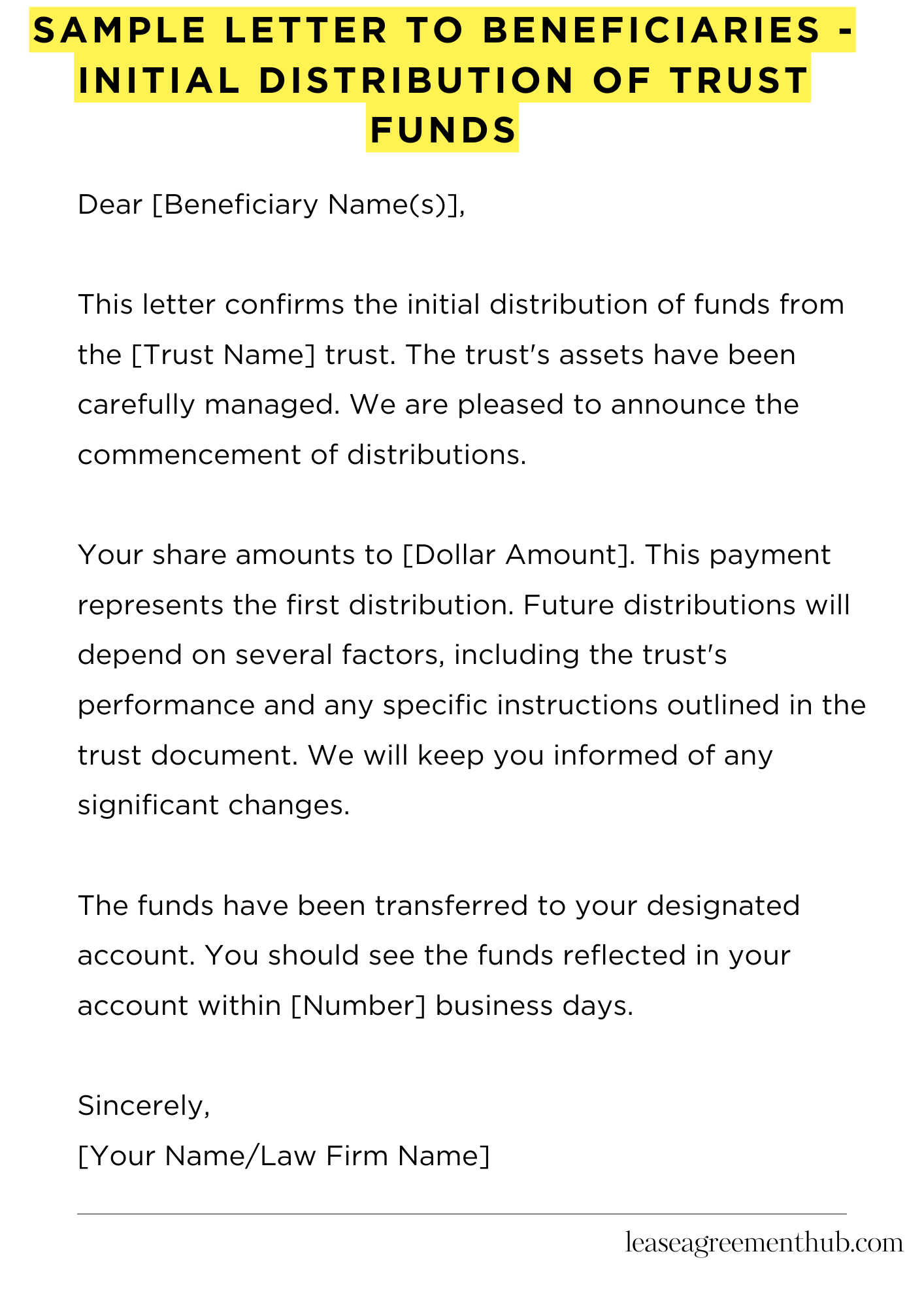
Sample Letter to Beneficiaries – Initial Distribution of Trust Funds
[Your Name/Law Firm Letterhead]
[Date]
[Beneficiary Name(s)]
[Beneficiary Address]
Dear [Beneficiary Name(s)],
This letter confirms the initial distribution of funds from the [Trust Name] trust. The trust’s assets have been carefully managed. We are pleased to announce the commencement of distributions.
Your share amounts to [Dollar Amount]. This payment represents the first distribution. Future distributions will depend on several factors, including the trust’s performance and any specific instructions outlined in the trust document. We will keep you informed of any significant changes.
The funds have been transferred to your designated account. You should see the funds reflected in your account within [Number] business days. Please review your account statement to confirm receipt. If you have any questions or require further clarification, please do not hesitate to contact us.
We are committed to transparency and maintaining open communication. We value your trust and look forward to assisting you further. We encourage you to contact us should any questions arise. You can reach us at [Phone Number] or [Email Address].
Sincerely,
[Your Name/Law Firm Name]
How to Write a Sample Letter to Beneficiaries – Initial Distribution of Trust Funds
Understanding the Nuances of Trust Fund Distribution
Distributing trust funds requires meticulous attention to detail. A poorly worded letter can sow discord and lead to protracted legal battles. Clarity is paramount. Each beneficiary needs to understand their allocation precisely and the conditions attached to the disbursement. This necessitates a formal, unambiguous approach.
Crafting a Compelling Salutation and Introduction
Begin with a formal salutation, addressing each beneficiary by their full legal name. Avoid casual greetings. The introduction should succinctly state the purpose of the letter – the initial distribution of trust funds. Mention the trust’s name and the date of its establishment for context. Set a professional, yet empathetic tone; reassuring beneficiaries that the process is transparent and equitable.
Detailing the Distribution: Precision is Key
This section requires the utmost precision. Clearly outline each beneficiary’s share. Specify the exact monetary amount or the description of assets allocated. If assets are non-monetary (e.g., properties or securities), provide a comprehensive description, including identification numbers if applicable. Ambiguity here is deleterious; it breeds mistrust and litigation.
Addressing Contingencies and Conditions
Many trust agreements incorporate specific conditions. These stipulations must be clearly articulated. If there are limitations on how the funds can be used, explicitly state them. Explain any vesting schedules or future distributions. This section necessitates a highly legalistic, yet accessible style, ensuring complete comprehension by all recipients despite potential lack of financial acumen.
Providing Payment Details and Timelines
Clearly state the method of payment (e.g., direct deposit, check). Include relevant account details or check numbers, as appropriate. Specify the expected timeframe for disbursement. If delays are anticipated, provide a plausible explanation and a revised timeframe. Transparency builds confidence.
Including Contact Information and Next Steps
Provide contact information for inquiries. Clearly state who beneficiaries should contact for questions or clarifications. Offer multiple avenues for communication (phone, email). Mention any subsequent distributions planned or any scheduled meetings. This fosters open communication and promotes a collaborative approach.
Review and Legal Counsel: A Prudent Approach
Before dissemination, meticulously review the draft. Ensure all information is accurate and consistent with the trust agreement. Seeking legal counsel is strongly recommended. A legal professional can ensure the letter complies with all applicable laws and regulations, minimizing potential legal ramifications. This is a vital penultimate step, preventing significant future difficulties.
FAQs about sample letter to beneficiaries – initial distribution of trust funds
What information should be included in the initial distribution letter?
The letter should clearly state the purpose (initial distribution of trust funds), the date of distribution, the amount distributed to each beneficiary, the method of payment (e.g., check, wire transfer), and any relevant tax information or instructions. It should also include contact information for any questions or concerns.
How formal should the tone of the letter be?
A formal and professional tone is generally recommended. While maintaining a respectful and courteous tone, the letter should be clear, concise, and avoid ambiguity to prevent misunderstandings.
Should the letter specify the source of the funds?
While not always mandatory, it’s generally good practice to briefly mention the source of the funds (e.g., “from the [Trust Name] Trust”). This adds transparency and context for the beneficiaries.
What if a beneficiary’s address is unknown?
If a beneficiary’s address is unknown, the letter should clearly state this and outline the steps being taken to locate them. This might involve requesting updated contact information or explaining the process for claiming the funds once the address is confirmed.
Is it necessary to send the letter via certified mail?
While not always required, sending the letter via certified mail with return receipt requested provides proof of delivery and can be beneficial in case of disputes or questions regarding receipt of the funds. Consult with legal counsel for specific requirements in your jurisdiction.
Related: