
An Ownership Transfer Letter Sample is a document used to officially transfer ownership of an asset, property, or item from one person to another. This letter serves as a record of the transaction and outlines the details of the transfer. Its purpose is to provide clarity and legal protection for both parties involved in the transfer.
In this article, we will share various templates and examples of Ownership Transfer Letters. These samples are designed to help you easily create your own letter. Whether you are transferring a vehicle, property, or any other asset, these examples will guide you in writing a clear and effective letter.
By using our provided templates, you can save time and ensure that your letter includes all necessary information. This will make the process smoother and more efficient for everyone involved. Writing an ownership transfer letter doesn’t have to be complicated, and our samples will show you how simple it can be.
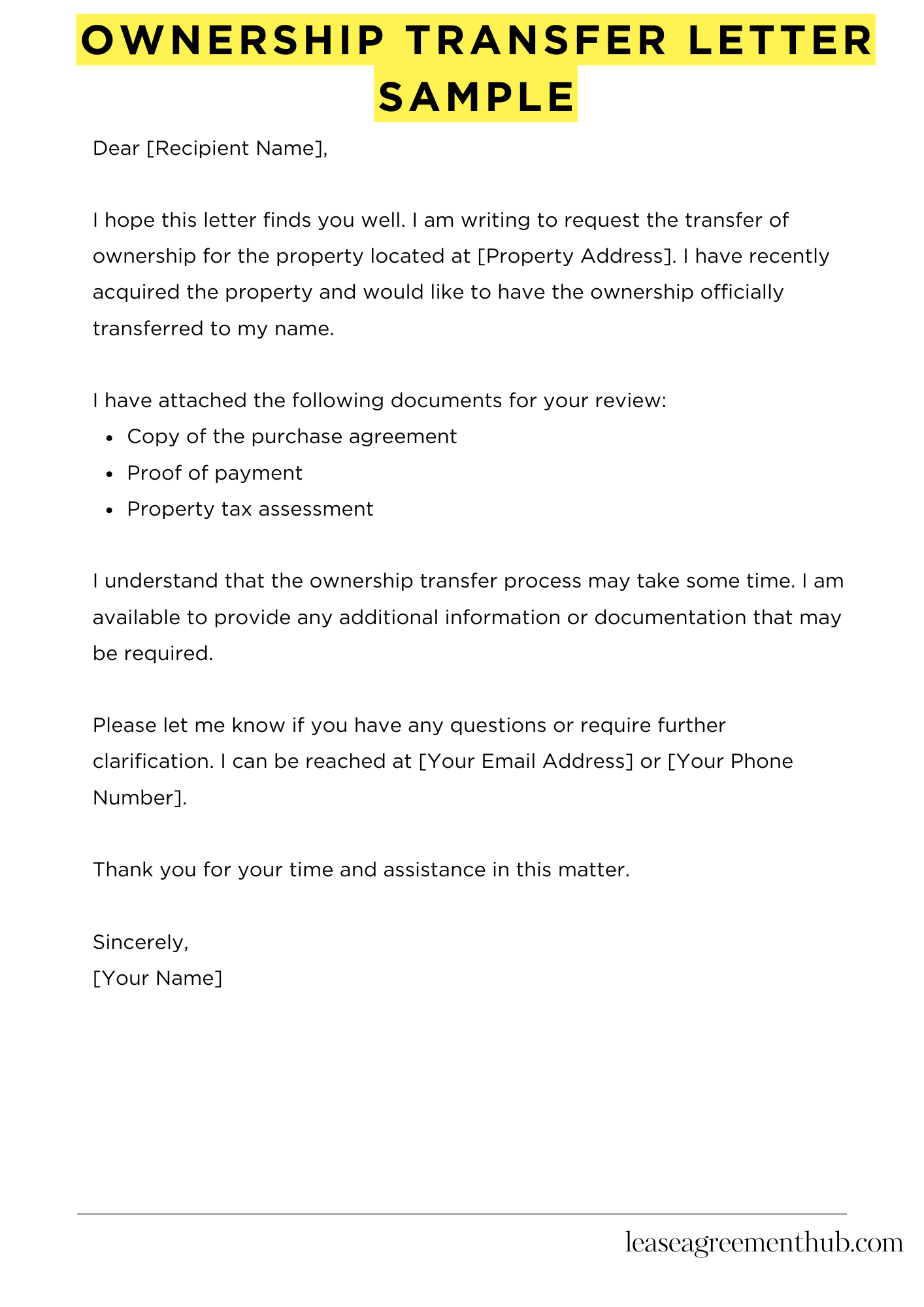
Ownership Transfer Letter Sample
[Your Name]
[Your Address]
[City, Postal Code]
[Email Address]
[Phone Number]
[Date]
[Recipient Name]
[Recipient Address]
[City, Postal Code]
Subject: Ownership Transfer Letter
Dear [Recipient Name],
I hope this letter finds you well. I am writing to request the transfer of ownership for the property located at [Property Address]. I have recently acquired the property and would like to have the ownership officially transferred to my name.
I have attached the following documents for your review:
- Copy of the purchase agreement
- Proof of payment
- Property tax assessment
I understand that the ownership transfer process may take some time. I am available to provide any additional information or documentation that may be required.
Please let me know if you have any questions or require further clarification. I can be reached at [Your Email Address] or [Your Phone Number].
Thank you for your time and assistance in this matter.
Sincerely,
[Your Name]
How to Write an Ownership Transfer Letter Sample
Transferring ownership of an asset, whether it’s a car, a property, or even a business, is a common occurrence. A well-written ownership transfer letter is essential to ensure a smooth and legally sound transition. This letter serves as official documentation, outlining the details of the transfer and protecting both the seller and the buyer. Let’s break down the key components of a successful ownership transfer letter.
1. Start with the Basics
Begin by clearly stating the purpose of the letter. You’re transferring ownership of a specific asset, so identify it clearly. Include the asset’s make, model, year, and any relevant identification numbers (VIN for a car, serial number for a piece of equipment). Also, include the date of the letter.
For example, you might start with:
“This letter confirms the transfer of ownership of a 2023 Toyota Camry, VIN number 1234567890ABC, from [Seller’s Name] to [Buyer’s Name].”
2. Specify the Transfer Details
The heart of the letter lies in the details. Clearly state the date of the transfer, the purchase price (if applicable), and any agreed-upon conditions. This could include any outstanding debts, warranties, or other relevant information. Be precise and avoid ambiguity.
For instance, you might include:
“This transfer is effective as of [Date]. The purchase price for the vehicle was [Amount], paid in full. The vehicle is sold as-is, with no warranties implied or expressed.”
3. Include Contact Information
Provide the complete contact information for both the seller and the buyer. This includes names, addresses, phone numbers, and email addresses. This ensures that both parties can be easily reached in case of any future questions or issues.
For example:
“Seller: [Seller’s Name], [Seller’s Address], [Seller’s Phone Number], [Seller’s Email Address]”
“Buyer: [Buyer’s Name], [Buyer’s Address], [Buyer’s Phone Number], [Buyer’s Email Address]”
4. Signatures and Witnesses
Both the seller and the buyer must sign the letter to confirm their agreement. It’s also a good practice to have the signatures witnessed by an impartial third party. This adds an extra layer of security and legal validity to the transfer.
For example:
“Signed by: [Seller’s Signature]”
“Witnessed by: [Witness’s Signature]”
“Signed by: [Buyer’s Signature]”
“Witnessed by: [Witness’s Signature]”
5. Retain Copies
Once the letter is signed, make sure both the seller and the buyer retain a copy for their records. This serves as proof of the transfer and can be helpful in resolving any future disputes.
Remember, this is a general guide. You may need to include additional information depending on the specific asset being transferred and the applicable laws in your jurisdiction. Always consult with a legal professional to ensure your ownership transfer letter is comprehensive and legally sound.
Related: