
An Experience Letter Format is a structured document that outlines a person’s work history and skills. It is typically issued by an employer to confirm the employee’s role, duration of employment, and performance. The purpose of this letter is to provide proof of experience for future job applications or professional opportunities.
In this article, we will share various templates and examples of Experience Letter Formats. These samples will help you understand how to create your own letter easily. Whether you are an employer drafting a letter or an employee requesting one, our examples will guide you through the process.
By using the templates provided, you can save time and ensure your letter meets professional standards. Each sample is designed to be clear and straightforward. You will find it simple to adapt them to your specific needs.
Experience Letter Format
Dear [Recipient Name],
This letter is to provide you with a sample experience letter format that you can use as a template for your own letters.
An experience letter, also known as a work experience letter, is a formal document that outlines your work history and responsibilities at a previous employer. It is often requested by potential employers or educational institutions. This letter helps them to understand your skills, experience, and accomplishments.
Here is a basic format for an experience letter:
- Heading: Include your name, address, phone number, and email address.
- Date: The date the letter was written.
- Recipient Information: The name and address of the person or organization you are sending the letter to.
- Salutation: A formal greeting such as “Dear [Recipient Name]”.
- Introduction: Start by stating the purpose of the letter. Clearly mention the company you are writing about and the dates of your employment.
- Body: This is the main part of the letter. Describe your job responsibilities, skills, and achievements. Be specific about your accomplishments. Quantify your results whenever possible. This demonstrates your impact on the company.
- Closing: End the letter with a professional closing such as “Sincerely” or “Best Regards.”
- Signature: Sign your name and type your full name below.
Sample Experience Letter:
[Your Name]
[Your Address]
[Your Phone Number]
[Your Email Address]
[Date]
[Recipient Name]
[Recipient Address]
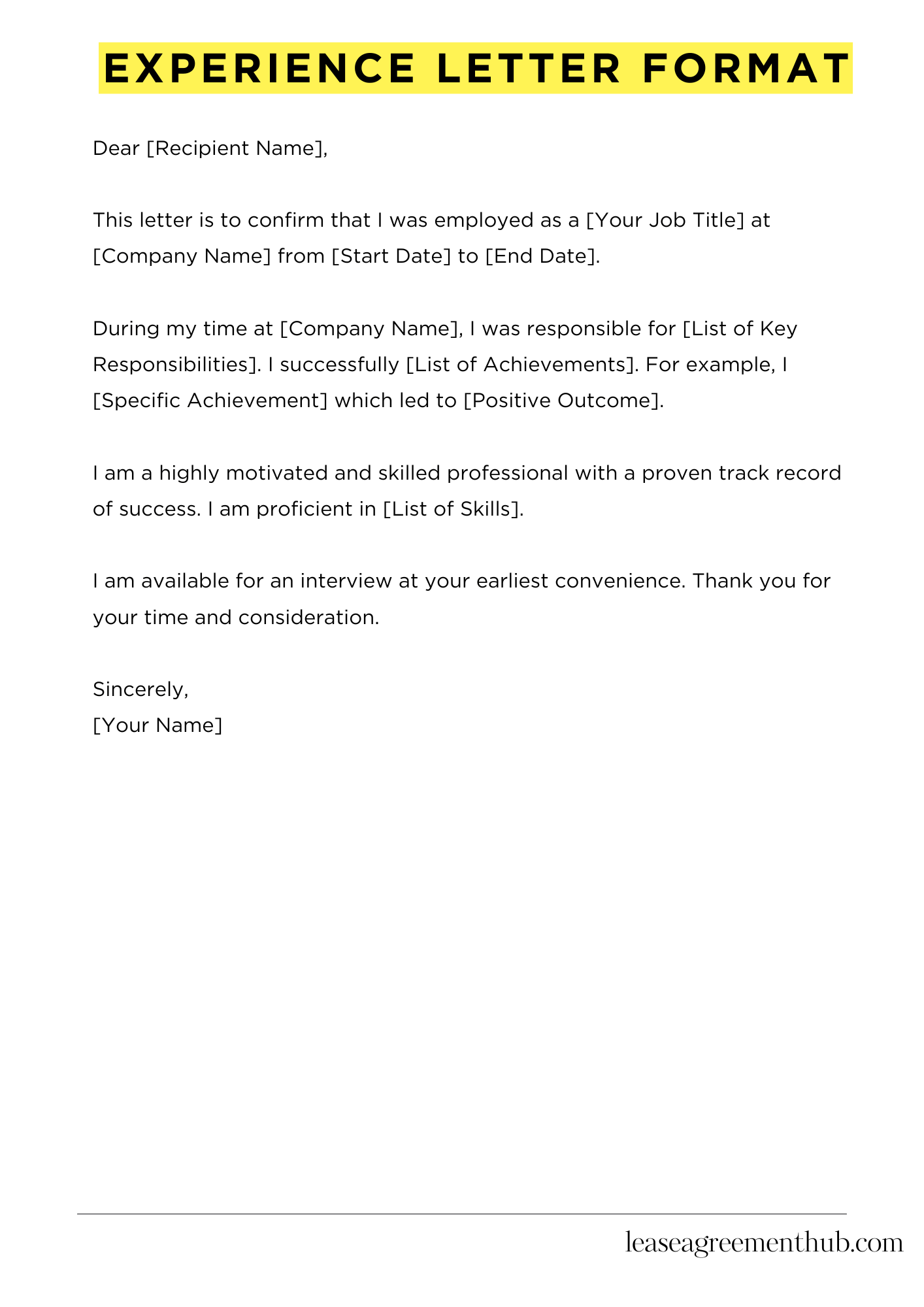
Dear [Recipient Name],
This letter is to confirm that I was employed as a [Your Job Title] at [Company Name] from [Start Date] to [End Date].
During my time at [Company Name], I was responsible for [List of Key Responsibilities]. I successfully [List of Achievements]. For example, I [Specific Achievement] which led to [Positive Outcome].
I am a highly motivated and skilled professional with a proven track record of success. I am proficient in [List of Skills].
I am available for an interview at your earliest convenience. Thank you for your time and consideration.
Sincerely,
[Your Name]
How to Write Experience Letter Format
An experience letter, also known as a work experience letter, is a formal document that outlines your work history at a particular company. It’s a crucial document for job applications, visa applications, and even personal references. A well-written experience letter can showcase your skills, achievements, and responsibilities, leaving a positive impression on the recipient.
Understanding the Purpose
The primary purpose of an experience letter is to provide a concise and accurate account of your work experience. It should highlight your key contributions, responsibilities, and skills acquired during your employment. The letter serves as a credible source of information for the recipient, verifying your work history and providing insights into your professional capabilities.
Essential Elements of an Experience Letter
A standard experience letter typically includes the following elements:
- Letterhead: Include the company’s name, address, and contact information.
- Date: The date the letter is written.
- Recipient’s Name and Address: The name and address of the person or organization the letter is addressed to.
- Subject Line: Clearly state the purpose of the letter, for example, “Experience Letter for [Your Name].”
- Introduction: Begin with a formal salutation and a brief introduction stating the purpose of the letter.
- Employment Details: Provide details of your employment, including your position, dates of employment, and department.
- Responsibilities and Achievements: Describe your key responsibilities and notable achievements during your employment. Use quantifiable data and specific examples to illustrate your contributions.
- Skills and Expertise: Highlight the skills and expertise you developed during your employment. This could include technical skills, soft skills, and industry knowledge.
- Closing Remarks: Express your gratitude for the opportunity to work at the company and offer your contact information for further inquiries.
- Signature: The letter should be signed by an authorized representative of the company, typically the HR manager or your direct supervisor.
Tips for Writing an Effective Experience Letter
Here are some tips for writing an effective experience letter:
- Use a professional tone: Maintain a formal and professional tone throughout the letter.
- Be concise and clear: Avoid using jargon or overly technical language. Keep the letter concise and to the point.
- Focus on achievements: Highlight your accomplishments and contributions to the company.
- Quantify your achievements: Use numbers and data to demonstrate the impact of your work.
- Proofread carefully: Ensure that the letter is free of grammatical errors and typos.
- Seek feedback: Ask a trusted colleague or friend to review the letter for clarity and accuracy.
Sample Experience Letter Format
Here’s a sample experience letter format to guide you:
[Company Letterhead]
Date: [Date]
To: [Recipient’s Name and Address]
Subject: Experience Letter for [Your Name]
Dear [Recipient’s Name],
This letter is to confirm that [Your Name] was employed with [Company Name] as [Your Position] from [Start Date] to [End Date]. During their employment, [Your Name] was responsible for [List of Key Responsibilities].
[Your Name] consistently demonstrated [Positive Qualities and Skills]. They were instrumental in [Highlight Notable Achievements].
We wish [Your Name] all the best in their future endeavors. Please do not hesitate to contact us if you have any further inquiries.
Sincerely,
[Signature]
[Name of Authorized Representative]
[Title]
By following these guidelines and incorporating your own experiences, you can craft a compelling experience letter that effectively showcases your professional journey and strengthens your applications.
Related: