When a business needs equipment, the financing choice usually comes down to two structures: an equipment finance agreement, which is essentially a loan, or a lease. Both put equipment to work with manageable payments, but they differ in ownership, tax treatment, balance sheet impact, and end-of-term options. Choosing the wrong one can cost real money in taxes, cash flow, and flexibility.
This guide compares equipment finance agreements and leases side by side, explains where each structure wins, and gives you a practical decision framework. The right answer depends on your tax situation, your balance sheet, and how long you plan to keep the equipment.
The Core Difference: Ownership
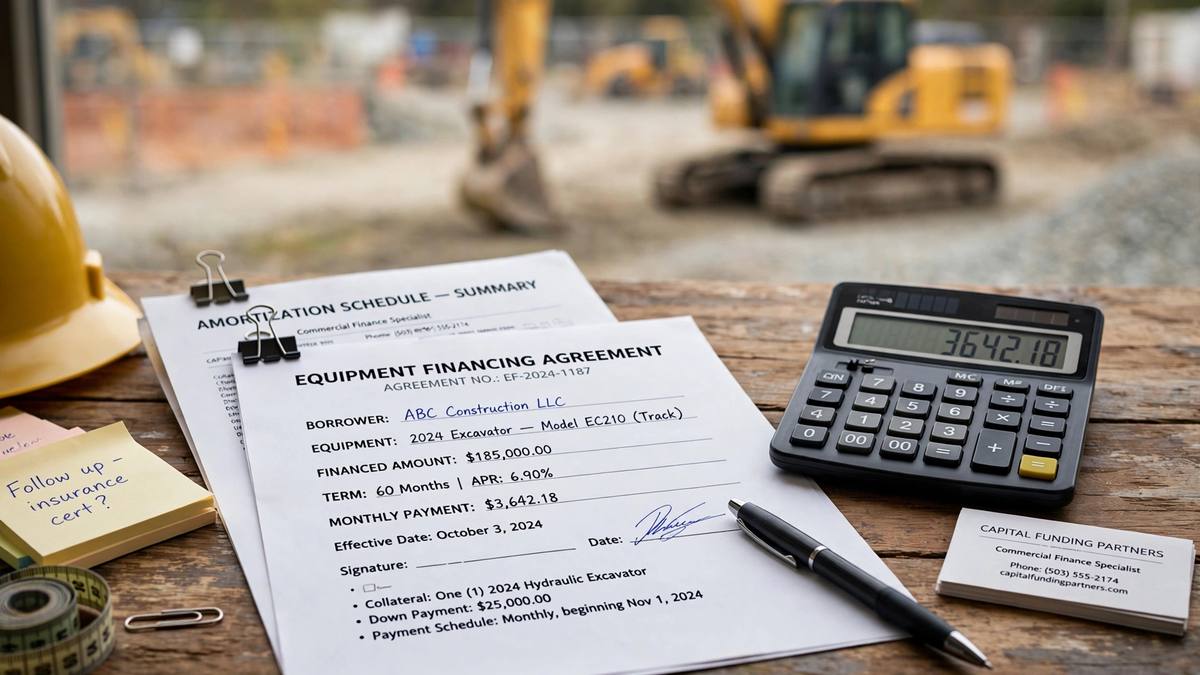
An equipment finance agreement, often called an EFA, is a loan secured by the equipment. The business owns the equipment from day one, while the lender holds a security interest, usually perfected with a UCC filing, until the loan is paid off. Then the lien is released and the business owns the asset free and clear.
A lease is a rental contract. The lessor owns the equipment, and the business pays for the right to use it over a fixed term. At the end, a fair market value lease offers return, renewal, or purchase options, while a dollar buyout lease transfers ownership for a nominal amount. During the term, the lessor holds title.
This ownership distinction drives almost everything else: who claims depreciation, how the transaction appears on the balance sheet, who bears residual value risk, and how much flexibility the business has to modify or sell the asset mid-term.
How Payments Compare
Lease payments are often lower than loan payments for the same equipment and term. The reason is the residual: in a fair market value lease, the lessee pays for depreciation during the term plus the lessor’s return, not the full cost of the asset. The lessor expects to recover the remaining value when the equipment is returned or sold.
EFA payments cover the full financed amount plus interest, because the borrower is buying the equipment outright. Payments run higher, but every payment builds equity in an asset the business will own. For equipment with a long useful life that the company plans to keep, that equity has real value.
Down payments differ too. Leases frequently require little or nothing down, sometimes just the first payment and a security deposit. EFAs typically require 10 to 20 percent down, though this varies by lender and credit profile. For cash-constrained businesses, the lease’s lighter upfront cost can be decisive. Understanding how lease payments are calculated helps you compare quotes accurately instead of comparing monthly figures that hide different assumptions.
Tax Treatment: Where the Math Gets Interesting
Tax treatment is often the deciding factor. Under an EFA, the business owns the equipment and claims depreciation deductions. Section 179 allows many businesses to deduct the full cost of qualifying equipment in the year it is placed in service, subject to annual limits. Bonus depreciation has historically allowed similar first-year write-offs, though the percentage has been phasing down under current law.
Under a true lease, the lessee deducts lease payments as an ordinary business expense while the lessor claims depreciation. For a profitable company that can use large first-year deductions, the EFA’s depreciation benefits often outweigh the lease’s payment deductions. For a company with limited taxable income, deductions have less value, which tilts the math toward leasing.
Classification matters enormously. A lease the IRS recharacterizes as a conditional sale loses its lease tax treatment. Dollar buyout leases and leases with bargain purchase options are generally treated as purchases, so the lessee gets depreciation rather than payment deductions. Have tax advisors confirm the intended treatment before signing, because the tax write-off comparison between leasing and buying only works if each structure is classified correctly.
Balance Sheet and Accounting Impact
Under ASC 842, both finance and operating leases now appear on the lessee’s balance sheet as right-of-use assets with corresponding liabilities. This was a major change from the old rules, under which operating leases stayed off the balance sheet. The lease type still affects the income statement pattern, with finance leases showing front-loaded expense and operating leases showing straight-line expense.
An EFA is straightforward: the equipment appears as an owned asset and the loan as a liability. There is no classification ambiguity, and lenders, investors, and sureties all read it the same way. For businesses with financial covenants, that predictability is an advantage.
The practical point: neither structure hides the obligation anymore. The old off-balance-sheet appeal of operating leases is largely gone. Base the decision on cash flow, tax, and flexibility, not accounting optics.
Flexibility and End-of-Term Options
Leases generally offer more end-of-term flexibility. A fair market value lease lets the business return obsolete equipment, renew at a reduced rate, or purchase at market value. For technology with short useful lives, that exit ramp is valuable. Returning a three year old server beats owning it.
EFAs offer a different kind of flexibility: ownership. The business can modify the equipment, sell it, or keep using it payment-free after the loan is retired. There are no return condition standards or end-of-term negotiations. For equipment the company will use for a decade, ownership simplicity wins.
Mid-term flexibility favors the EFA as well. Selling or refinancing owned equipment is a business decision. Exiting a lease early usually means paying the remaining balance plus penalties, and subleasing often requires the lessor’s consent. Companies in volatile industries should weigh this carefully.
When an Equipment Finance Agreement Wins
The EFA usually wins when the business plans to keep the equipment well beyond the financing term. If a manufacturer will run a CNC machine for twelve years, paying it off in five and running it payment-free for seven is hard to beat. Total cost of ownership favors buying when the asset’s useful life substantially exceeds the financing term.
EFAs also win for profitable companies that can use depreciation deductions, for equipment the business will customize, and for assets with strong resale value the company wants to capture. A dollar buyout lease can mimic some of these benefits, but it is generally taxed as a purchase anyway, so a straightforward EFA is often cleaner.
When a Lease Wins
Leasing usually wins for equipment that becomes obsolete quickly: technology, medical imaging devices, and telecom gear. The end-of-term exit lets the business upgrade on a predictable cycle without carrying disposal risk on outdated assets.
Leasing also wins when cash flow is the priority. Lower payments and minimal upfront costs preserve working capital. For growing businesses, the cash saved can go into inventory, hiring, or marketing, where it may earn a higher return than equity in owned equipment.
Finally, leasing suits businesses that value simplicity. Handing equipment back at lease end is administratively easier than selling used assets. For companies without a used equipment sales function, that convenience has real value. Businesses weighing vehicle options face a similar calculation, as the tax deductions for business vehicle leasing show how payment deductibility shapes the decision.
A Practical Decision Framework
Start with the holding period. If you will keep the equipment for its full useful life, lean toward an EFA. If you will replace it before it wears out, lean toward a lease. This one question resolves many decisions.
Next, run the tax math with your advisor. Compare the present value of depreciation deductions under an EFA against lease payment deductions under a true lease, using your actual marginal tax rate. The winner of this comparison often determines the winner overall.
Then consider cash flow timing. Model both structures month by month, including down payments, deposits, and end-of-term costs like return shipping or purchase options. A structure that wins on total cost can still lose if its cash demands arrive at the wrong time.
Finally, assess obsolescence risk honestly. Businesses tend to overestimate how long they will keep technology equipment and underestimate how fast it depreciates. If the equipment may be outdated before the financing ends, the lease’s exit option is worth a premium.
Equipment finance agreements and leases are both sound tools, and sophisticated businesses use both for different assets. The mistake is defaulting to one structure for everything. Match the financing to the asset’s life, your tax position, and your cash flow needs, and revisit the decision for each major acquisition.