A Sample Experience Letter is a document that outlines a person’s work history and skills. It serves as proof of employment and highlights the contributions made during their time with a company. This letter is often required when applying for new jobs or further studies.
In this article, we will provide various templates and examples of Sample Experience Letters. These samples are designed to help you create a personalized letter that fits your unique situation. Whether you need a letter for a job application or a reference, we’ve got you covered.
By using our provided samples, you can save time and effort. Writing an experience letter can be straightforward with the right guidance. Simply follow the examples to craft a letter that effectively showcases your experience and qualifications.
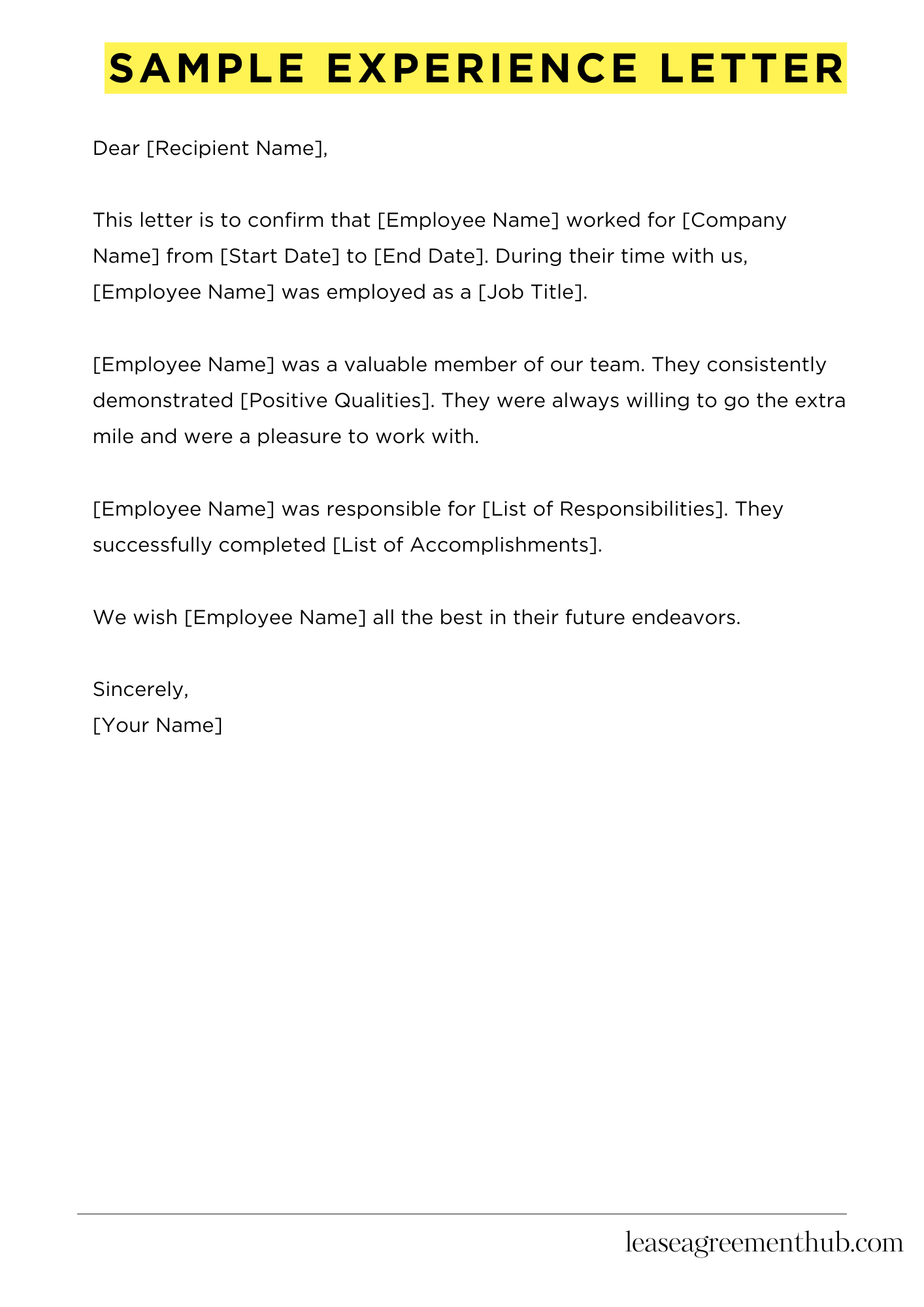
Sample Experience Letter
[Your Name]
[Your Address]
[Your Phone Number]
[Your Email Address]
[Date]
[Recipient Name]
[Recipient Title]
[Recipient Company]
[Recipient Address]
Dear [Recipient Name],
This letter is to confirm that [Employee Name] worked for [Company Name] from [Start Date] to [End Date]. During their time with us, [Employee Name] was employed as a [Job Title].
[Employee Name] was a valuable member of our team. They consistently demonstrated [Positive Qualities]. They were always willing to go the extra mile and were a pleasure to work with.
[Employee Name] was responsible for [List of Responsibilities]. They successfully completed [List of Accomplishments].
We wish [Employee Name] all the best in their future endeavors.
Sincerely,
[Your Name]
How to Write a Sample Experience Letter
A well-crafted experience letter can be a powerful tool for showcasing your skills and accomplishments to potential employers. It provides a detailed account of your professional journey, highlighting your key experiences and demonstrating your value to a company. This letter serves as a bridge between your resume and an interview, allowing you to elaborate on your qualifications and provide concrete examples of your abilities.
1. Understand the Purpose
Before you start writing, it’s crucial to understand the purpose of an experience letter. It’s not just a summary of your resume; it’s an opportunity to tell a story. Think of it as a narrative that showcases your skills, experience, and accomplishments in a way that resonates with the reader.
2. Structure Your Letter
A well-structured experience letter is essential for clarity and impact. Here’s a recommended format:
- Introduction: Start by introducing yourself and stating the purpose of the letter. Briefly mention the position you’re applying for and your relevant experience.
- Body Paragraphs: Each paragraph should focus on a specific experience or skill. Provide details about your responsibilities, accomplishments, and the impact of your work. Use quantifiable metrics whenever possible to demonstrate your achievements.
- Conclusion: Summarize your key skills and experiences, reiterate your interest in the position, and express your enthusiasm for the opportunity.
3. Highlight Your Key Skills and Accomplishments
The body of your experience letter is where you showcase your value to the employer. Focus on skills and accomplishments that are relevant to the position you’re applying for. Use strong verbs and action words to describe your contributions and achievements. For example, instead of saying “I worked on a project,” say “I successfully implemented a new project management system that streamlined workflows and increased efficiency by 20%.”
4. Proofread Carefully
Before submitting your experience letter, proofread it carefully for any errors in grammar, spelling, and punctuation. Ask a friend or colleague to review it for you as well. A well-written and error-free letter demonstrates your professionalism and attention to detail.
5. Tailor Your Letter to Each Application
While you can use a general template for your experience letter, it’s important to tailor it to each specific job application. Research the company and the position you’re applying for and highlight the skills and experiences that are most relevant. This demonstrates that you’ve taken the time to understand the company and its needs.
Writing a compelling experience letter can be a valuable investment in your job search. By following these steps, you can create a document that showcases your skills, experience, and passion for the position, ultimately increasing your chances of landing your dream job.
Related: